Common Toilet Problems in Fountain Valley, CA
Most toilet problems fall into six patterns: a clog, a toilet that runs, a leak, a weak flush, a toilet that will not flush, and an overflow. Each pattern has its own usual causes, and the symptom you see is often the clearest clue to the cause. This page covers all six, what they usually mean, what you can safely check, and when the problem needs a local toilet repair professional.
Toilet repair assistance for homes, rentals, and local properties.
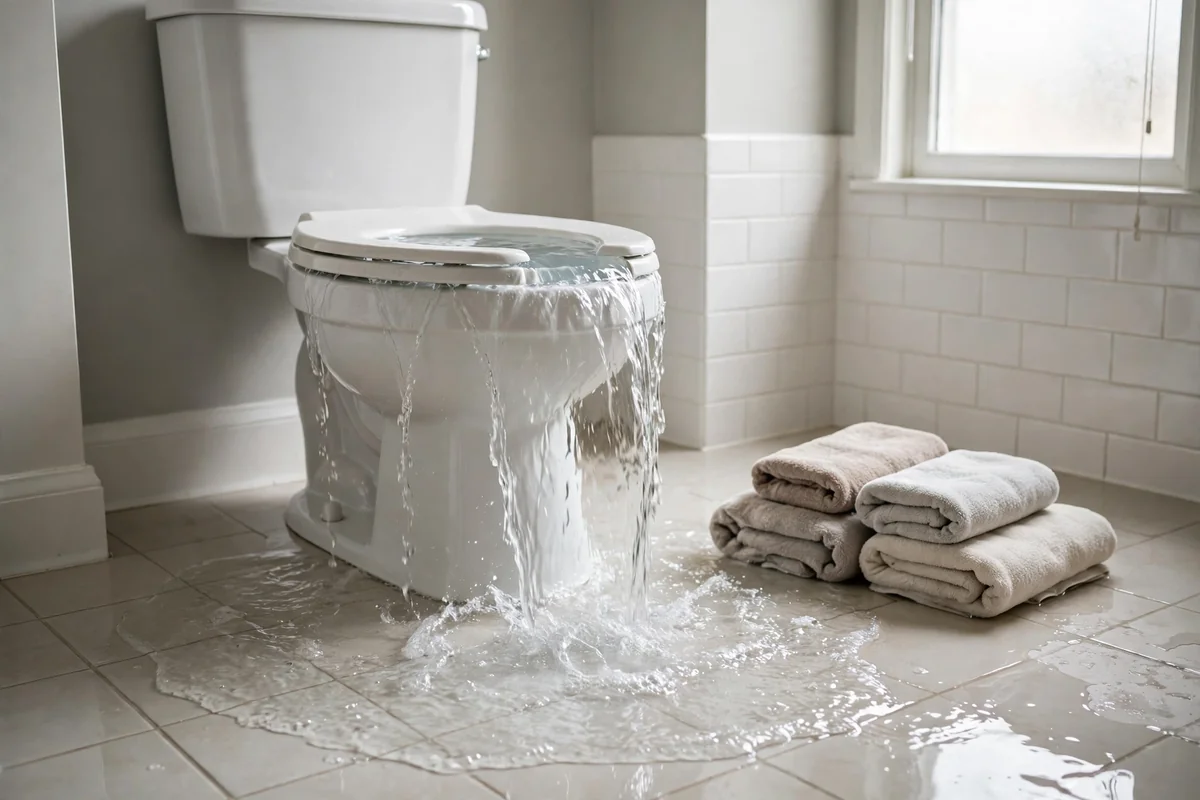
A toilet overflowing onto the bathroom floor with towels nearby.
Six Toilet Problems, Six Different Causes
Clogged Toilet
Blockage in the trap, bowl or drain line. A single clog is ordinary; a clog that returns every week points deeper.
Learn more →Running Toilet
Water escaping past the flapper or a fill valve that will not shut off, so the tank keeps refilling.
Learn more →Leaking Toilet
Water from the tank, the supply line or the seal under the toilet, each with a different repair.
Learn more →Weak Flush
Low tank level, a chain that does not lift the flapper fully, or mineral deposits blocking the rim jets.
Learn more →Toilet Will Not Flush
Handle, chain, flapper or fill valve failure, or a tank that is not filling at all.
Learn more →Toilet Overflow
Bowl water rising toward the rim, usually from a clog, with the shutoff valve as the first response.
Learn more →Diagnose by Symptom
| Symptom | Most likely cause | First safe step |
|---|---|---|
| Bowl drains slowly | Partial blockage in the trap or drain line. | Try a flange plunger once, then check other fixtures. |
| Bowl water rises when flushed | Clog in the trap or drain, or a vent problem. | Do not flush again; turn off the shutoff valve if it keeps rising. |
| Toilet runs without stopping | Flapper not sealing, or fill valve not shutting off. | Do the dye test to tell which part is leaking. |
| Tank refills every few minutes | Slow flapper seep, the early stage of a running toilet. | Do the dye test; the flapper is the usual cause. |
| Water at the base after flushing | Wax ring or flange failure under the toilet. | Stop using the toilet and call; every flush adds water under it. |
| Water at the base all the time | Supply line, shutoff valve, or a crack in the bowl. | Turn off the shutoff valve and mop up the water. |
| Flush is weak or incomplete | Low tank level, loose chain, or blocked rim jets. | Check the tank water level and the chain slack. |
| Handle moves but nothing happens | Chain disconnected, or flapper not lifting. | Lift the tank lid and check whether the chain is attached. |
| Gurgling from the tub when flushing | Partial blockage in a shared drain, or a blocked vent. | Do not keep flushing; call for a drain check. |
| Sewage odour near the toilet | Failed wax seal, dry trap, or a drain problem. | Check whether the toilet rocks; call if the odour persists. |
| Bowl water level drops on its own | Blocked vent, or a leak in the trapway. | Note whether other fixtures are affected and call. |
Clogs and Slow Drains
A clog is a blockage that prevents the bowl emptying properly, and the pattern of the clog is the clearest clue to where it sits. A single clog after too much paper is ordinary and usually clears with a flange plunger. A clog that returns every week, even with normal use, usually means something is caught in the trapway, catching paper a little more with every flush, or a partial blockage further down the drain line that plunging cannot reach. A toilet that drains slowly but does not clog outright is describing a partial blockage: water is getting past, but not fast enough to create a proper flush.
Wipes are the most common cause of recurring clogs that homeowners do not suspect. Wipes sold as flushable do not break apart in water the way toilet paper does, and they snag in the trap and in the drain line, building up into a blockage over weeks. Paper towels, tissues, cotton products and feminine hygiene products behave the same way. If a toilet clogs repeatedly and wipes or similar products have been flushed, stopping that habit is the first step, but the blockage that has already formed may still need a closet auger or a drain clearing to remove.
The drain line beyond the toilet is the other place a recurring clog can sit. The toilet sends more water at once than any other fixture in the home, so it is usually the first fixture to show a drain problem, even when the blockage is well beyond the bathroom. A partial blockage in the drain, a sagging section of pipe, or a blocked vent on the roof can all make a toilet clog more often without any blockage in the toilet itself. If the tub gurgles or backs up when the toilet flushes, or more than one fixture is slow at the same time, the problem is in a shared line and the toilet alone is not the cause. The clogged toilet repair page covers clogs in full, including what to try safely and what not to put down a toilet.
Running Toilets and Phantom Flushes
A running toilet is a tank that cannot finish its cycle. Water escapes from the tank into the bowl past a flapper that no longer seals, or the fill valve will not shut off, so water keeps entering the tank and spilling into the overflow tube. The sound is a hiss or trickle that never quite stops, and the water waste continues day and night. A toilet that refills every few minutes, sometimes called a phantom flush, is the same fault at an earlier stage: the flapper seeps slowly, the tank level drops, and the fill valve opens to top it up, which sounds like a flush that nobody triggered.
The dye test is the simplest way to tell which part has failed. Add a few drops of food colouring to the tank water, wait fifteen minutes without flushing, and look at the bowl. If colour has appeared in the bowl, water is leaking past the flapper or the flush valve. If the bowl is clear but water is spilling into the overflow tube, the fill valve is not shutting off at the right level. That distinction decides whether the answer is a flapper, a fill valve, or a chain adjustment, and it is worth doing before any part is bought. The running toilet repair page explains the test and each cause in detail, including the chain slack that is so often the culprit after a repair.
A running toilet is easy to live with for too long, because there is no water on the floor and the sound becomes background noise. The cost is in water use and in wear on the fill valve, which cycles far more often than it was designed to. The United States Environmental Protection Agency notes that household leaks can waste 180 gallons of water per week, and toilets are often the source. Fixing the flapper or fill valve stops the waste at its source, and the household returns to normal water use without changing any habits.
Leaks, Rocking and Water at the Base
Water at the base of a toilet is the symptom that most often gets underestimated, because the amount of water on the floor can look small. The damage is not on the floor, it is under the toilet, where water soaks into the subfloor with every flush. A wax ring that has failed lets a small amount of water escape under the toilet each time it is used, and that water cannot be seen, mopped or dried. Over weeks it softens flooring, loosens tiles and creates conditions where damp and mould problems develop in the floor cavity. A stain on the ceiling below an upstairs bathroom is often the first visible sign, and by then the subfloor upstairs may already be soft.
A toilet that rocks is the clearest warning of a base leak, even if no water is visible yet. The wax ring is not designed to flex, and every movement of the toilet breaks the seal a little more. A rocking toilet has usually already broken its seal, and tightening the bolts at the base will not restore it. Tightening the bolts against a corroded or broken flange can crack the porcelain, which turns a seal replacement into a toilet replacement. The toilet needs to be lifted, the flange inspected, and the toilet reset on a new seal, and the floor underneath checked at the same time.
Not every wet patch around a toilet is a base leak. Condensation on the outside of the tank, sometimes called a sweaty tank, forms when warm humid bathroom air meets cold tank water, and it runs down the tank and pools on the floor. It looks like a leak but the floor under the toilet stays dry, and it is most noticeable after hot showers. A supply line drip is another possibility, and it is usually visible behind the toilet where the line connects to the shutoff valve. The toilet leak repair page covers each of these in detail, with a table for finding the source of a leak from where and when the water appears.
Weak Flushes and Toilets That Will Not Flush
A weak flush is a toilet that does not clear the bowl properly, needs two or three flushes, or leaves waste behind even though the tank fills. The cause is usually one of four things: the tank water level is too low, the chain has too much slack so the flapper closes before the tank has emptied, mineral deposits are blocking the rim jets under the bowl rim, or a partial clog in the trap is slowing the drain. Each cause has a different fix, which is why a weak flush is worth diagnosing rather than guessing at. Check the tank water level first: it should sit about half an inch to three quarters of an inch below the top of the overflow tube, and near the fill line marked inside the tank.
A toilet that will not flush at all is usually a handle, chain or flapper problem. If the handle moves without any resistance, the chain has probably come off the flapper or the trip lever. If the handle is stiff or broken, the lever arm itself may be bent or disconnected. If the tank is not filling, the fill valve or the supply valve is the cause. Lift the tank lid carefully and look at the chain and flapper while someone else presses the handle, and the fault is usually visible. Do not force a stiff handle, because the lever arm can snap, and do not force a stuck shutoff valve, because it can leak.
Mineral buildup deserves a closer look, because it is the cause of weak flushes that develop gradually over years. Hard water leaves calcium deposits in the small rim jets under the bowl rim, where they narrow the passages that direct water into the bowl, and on the flapper seat, where they prevent a clean seal. A toilet that flushed strongly when it was new can lose power so slowly that the change is easy to miss. Cleaning the rim jets and replacing a hardened flapper are two of the most common answers to that slow decline, and they are worth trying before concluding that the toilet itself needs replacing.
Overflows: What to Do First
Turn off the shutoff valve
Find the valve behind the toilet, low on the wall or floor, and turn it clockwise until it stops. This prevents more water entering the tank and the bowl.
Do not flush again
A second flush adds more water to a bowl that cannot drain. Leave the handle alone until the water level has dropped.
Push the flapper down
Lift the tank lid carefully and push the flapper at the bottom of the tank down so it seals. This stops tank water flowing into the bowl.
Mop up and call
Mop up water on the floor, keep people and pets away from any water that may contain waste, and call for help if the bowl keeps rising or sewage is involved.
Toilet Problems in Fountain Valley Homes
Fountain Valley homes show the same six toilet problems as homes anywhere, but the mix is shaped by the age of the housing. Most of the city was built in the 1960s and 1970s as single-family tract homes, and many bathrooms still have toilets from an earlier replacement, or from the first generation of low-flow models installed in the 1990s. That mix means a single street can contain toilets of three different ages, each with different parts and different flushing behaviour, and a symptom that means one thing in a modern toilet can mean something else in a 1990s model. A local professional who sees that mix regularly can usually tell from the symptom and the age of the fixture which parts are likely involved.
The hard water across Orange County is the other local factor. Mineral deposits build up in rim jets, on flapper seats and inside fill valves over years, gradually weakening the flush and preventing seals from closing. A toilet that flushed well for years can lose power without any single event to blame, and the change is easy to miss because it happens so slowly. That slow decline is one reason a toilet that has never been a problem can start clogging or running in its second or third decade of use, and why a flapper that sealed cleanly when new can start to seep as deposits build up on its seat.
Rental properties and multi-unit buildings add a further pattern. A problem in a ground-floor unit can be the first sign of a shared drain problem, and a leak at the base of an upstairs toilet can stain the ceiling of the unit below before anyone upstairs notices water on the floor. When reporting a toilet problem in a rental or a multi-unit property, note which unit and floor the toilet is on, whether other units have similar symptoms, and whether the problem affects one toilet or several. Those details help a local professional decide whether the cause is in the fixture or in a shared drain, and they are the same details that help you decide whether the problem can wait or needs prompt attention.
Call for Help With a Toilet Problem in Fountain Valley
Describe what your toilet is doing, when it started, and whether other fixtures are affected, and connect with a local toilet repair professional who can discuss the help available. Call now through the contact page.
Fountain Valley Toilet Repair Pros is a referral service connecting customers with local toilet repair professionals; it is not itself the service company.
Frequently Asked Questions
What are the most common toilet problems?
The most common problems are clogs, running toilets, leaks at the base or tank, weak flushes, toilets that will not flush, and overflows. Most of them come down to a small number of causes: a worn flapper or fill valve, a failed wax ring, a blockage in the trap or drain, or mineral buildup in the rim jets.
Why does my toilet gurgle?
Gurgling usually means air is trapped in the drain or vent system. It can happen when a partial blockage sits further down the drain line, or when the vent pipe is blocked. If the tub gurgles when the toilet flushes, or more than one fixture gurgles, the problem is in a shared line rather than in the toilet alone.
Why does the water level in my toilet bowl drop?
A bowl water level that drops on its own can mean a blocked vent is siphoning water out of the trap, or a crack in the trapway is letting water escape. It can also happen after a strong flush in another fixture. If the level keeps dropping, the vent or the toilet itself needs to be checked.
What causes a sewage smell near the toilet?
A sewage odour near a toilet usually means the wax seal under the toilet has failed and sewer gas is entering the home, or a drain trap has dried out, or a drain problem is allowing gas back through the line. A rocking toilet and a failed wax seal are the most common cause, and the seal should be checked promptly.
Why does my toilet flush by itself at night?
A toilet that sounds as if it flushes by itself is usually refilling because a worn flapper is letting tank water seep slowly into the bowl. The tank level drops, the fill valve opens to top it up, and the refill sounds like a flush. Replacing the flapper stops the cycle.
Can a toilet problem affect other fixtures in my home?
Yes. The toilet, tub, sink and shower in a bathroom often share a drain line, and a partial blockage or a blocked vent in that line can affect all of them. If the tub drains slowly or gurgles when the toilet flushes, the problem is in the shared line rather than in the toilet alone.
How do I know if a toilet problem is in the drain or the toilet?
Check whether other fixtures are affected. If only one toilet is affected and a plunger clears it, the problem is probably in that toilet. If more than one fixture is slow, gurgling or backing up, or the problem returns in every bathroom, the drain line or vent is the likely cause.
What should I never do when my toilet overflows?
Do not flush again, because that adds more water to a bowl that cannot drain. Do not use chemical drain cleaner in a toilet, because it can damage the wax seal and creates a hazard for anyone who later plunges or augers it. Turn off the shutoff valve behind the toilet, mop up the water, and call for help.
Why is my toilet handle loose?
A loose handle usually means the nut holding the handle to the tank has worked loose, or the trip lever inside the tank is bent or worn. If the handle moves but the toilet does not flush, the chain has probably come off the flapper. The handle, lever and chain are replaceable parts.
Can a cracked toilet be repaired?
A crack in the bowl or tank cannot be reliably sealed, because porcelain under constant water pressure does not hold a patch. A crack below the waterline will leak, and porcelain can fail without warning. A cracked toilet is a replacement question, and the toilet replacement page explains the decision.
Need Toilet Repair? Call Now
Describe the toilet problem and discuss the help available for your specific situation.