Toilet Repair in Fountain Valley, CA
Toilet repair covers the diagnosis and fixing of the problems that stop a toilet working properly: clogs, running tanks, leaks, weak flushes and broken flushing parts. Most toilet problems are repairs rather than replacements, and most repairs involve a small number of parts inside the tank or a seal under the toilet. This page explains what toilet repair includes, how the common problems are identified, and what happens when you call for help in Fountain Valley.
Toilet repair assistance for homes, rentals, and local properties.
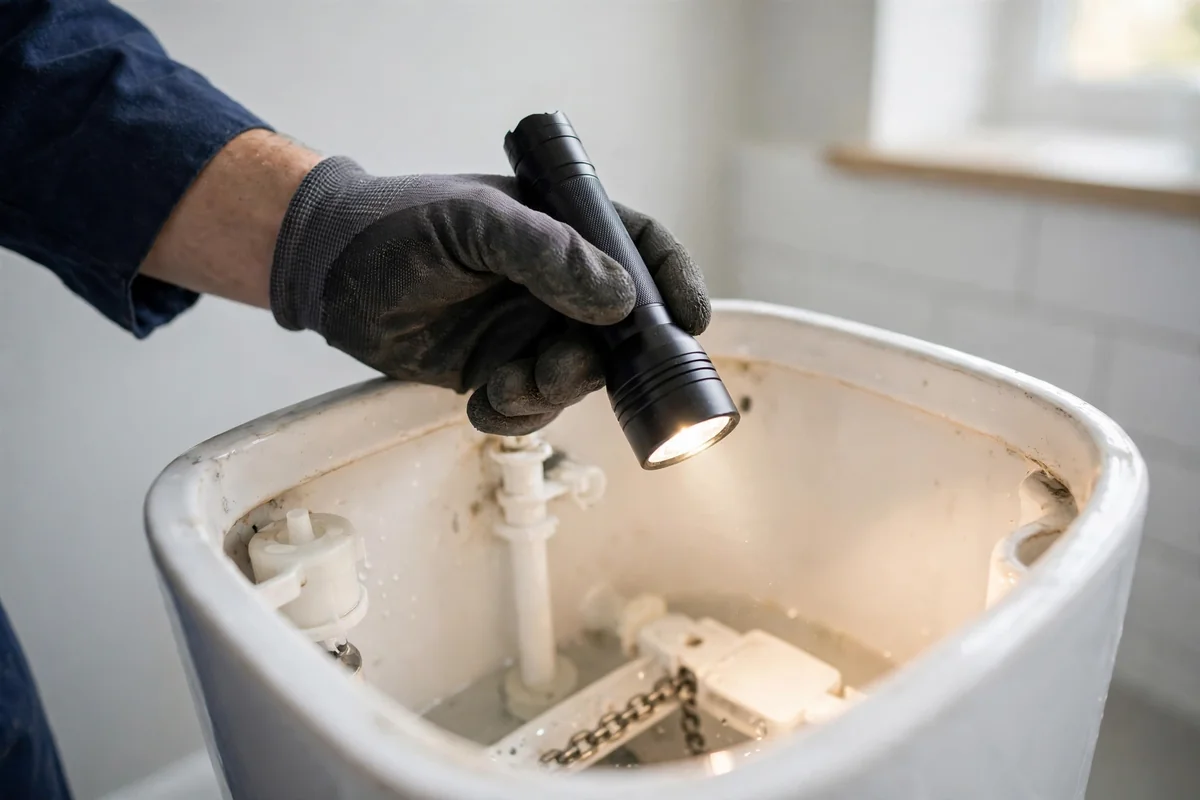
Inspecting the inside of a toilet tank with a flashlight.
What Toilet Repair Covers
A toilet looks simple from the outside, but it is two connected systems working together. The tank stores water and releases it in a fast, controlled rush when you flush. The bowl and its internal trapway receive that water, create a siphon, and carry waste into the drain. A seal under the toilet, the wax ring, keeps the connection to the floor drain watertight, and a supply line with a shutoff valve feeds the tank. When any part of that chain fails, the symptom shows up at the bowl: a clog, a run, a leak, a weak flush or no flush at all.
Toilet repair starts by finding which part of the chain has failed. A toilet that runs is usually a tank problem. A toilet that clogs repeatedly is usually a trap or drain problem. A toilet that leaks at the base is usually a seal problem. A toilet that flushes weakly can be any of several problems, from a low tank level to mineral deposits in the rim jets. The diagnosis matters because the parts are inexpensive and the labour is straightforward once the cause is known, while guessing at parts can mean replacing a flapper when the real problem is a fill valve, or plunging a toilet whose clog sits further down the line.
The work itself falls into a handful of familiar jobs. Inside the tank, that means replacing a flapper, a fill valve, a flush valve, a handle and trip lever, or a tank-to-bowl gasket. At the base, it means lifting the toilet, inspecting the floor flange, and resetting the toilet on a new wax ring or non-wax seal. In the bowl and trap, it means clearing a blockage with a closet auger, the short snake designed for toilets, rather than a standard drain snake that can scratch porcelain. For a toilet that cannot be repaired sensibly, replacement means removing the old unit, checking the flange and floor, setting the new toilet, connecting a new supply line, and testing it with several flushes.
Toilet repair in Fountain Valley also has to fit the homes it serves. Many Fountain Valley houses were built in the 1960s and 1970s, and their bathrooms have seen several generations of fixtures. A home may have one original-style toilet, one early low-flow replacement from the 1990s and one modern WaterSense model, each with different parts and different flushing behaviour. A local professional who sees that mix regularly can usually tell from the symptom and the age of the fixture which parts are likely involved, and can explain whether a repair or a replacement is the sensible answer for that particular toilet.
How a Toilet Works, in Plain Terms
| Part | What it does | What happens when it fails |
|---|---|---|
| Flapper | Seals the tank outlet and lifts to release water when you flush. | Water seeps into the bowl, the toilet runs or refills on its own. |
| Fill valve | Refills the tank after a flush and shuts off at the set water level. | Tank overfills, refills slowly, hisses, or never shuts off. |
| Flush valve and overflow tube | Controls the release of tank water and prevents the tank overflowing. | Weak flush, water leaking into the bowl, or tank overfilling. |
| Handle, trip lever and chain | Lifts the flapper when you press the handle. | Toilet will not flush, flushes weakly, or the handle feels loose. |
| Rim jets and siphon jet | Direct tank water around the bowl rim and into the trap to create the siphon. | Mineral buildup weakens the flush and leaves the bowl uncleared. |
| Trapway | Curved passage inside the toilet that holds water to block sewer gas. | Objects caught inside cause repeated clogs and slow draining. |
| Wax ring and flange | Seals the toilet to the floor drain. | Water leaks at the base, the toilet rocks, sewer gas can enter. |
| Supply line and shutoff valve | Feeds water to the tank and lets you isolate the toilet. | Drips, corrosion, or a valve that will not turn when you need it. |
Signs Your Toilet Needs Repair
- The toilet runs for more than a minute after flushing, or never stops running at all.
- The tank refills every few minutes even though nobody has used the toilet, sometimes called a phantom flush.
- The bowl drains slowly, the water level rises when you flush, or the toilet clogs with normal use.
- Water appears on the floor around the base, either after flushing or all the time.
- The toilet rocks, shifts or feels loose when you sit on it.
- The flush is weak, incomplete, or needs two or three attempts to clear the bowl.
- The handle is loose, stiff or disconnected, or the toilet will not flush at all.
- You hear hissing, gurgling or trickling from the tank between flushes.
- A sewage odour appears near the toilet, or other drains gurgle when the toilet flushes.
- The bowl water level drops on its own, or a stain appears on the ceiling below an upstairs bathroom.
Common Causes Behind Toilet Problems
Most running toilets come down to rubber and water. The flapper is a rubber seal that sits in water all day, every day, and over years it hardens, warps or develops mineral deposits on its seat. Once it stops sealing cleanly, tank water trickles into the bowl, the tank level drops, and the fill valve tops it up again. That cycle repeats for as long as the flapper leaks. The fill valve itself can also fail, either by not shutting off when the tank reaches its level or by refilling too slowly because of debris or wear. A chain that is too tight holds the flapper slightly open, and a chain with too much slack does not lift it far enough, so a weak flush and a running toilet can share the same small cause.
Clogs have a different set of causes, and the pattern of the clog usually gives the cause away. A single clog after too much paper is ordinary. A clog that returns every week often means an object is caught in the trapway, catching paper a little more with every flush, or a partial blockage further down the drain line that plunging cannot reach. Wipes sold as flushable are a frequent contributor, because they do not break apart in water the way toilet paper does, and they snag on rough spots in the pipe. A blocked vent on the roof can also make a toilet flush weakly and clog more often, because the drain needs air behind the water to flow properly. If the tub gurgles or backs up when the toilet flushes, the problem is in the shared line rather than in the toilet alone.
Leaks split into three locations, and the location decides the repair. Tank leaks come from the flapper, the fill valve, the tank-to-bowl bolts and gaskets, or a crack in the tank itself. Supply leaks come from the braided line or the shutoff valve behind the toilet, and a bulging supply line or a corroded nut is a warning that it may fail. Base leaks come from the wax ring or the flange, and they are the ones that damage floors, because the water goes under the toilet rather than onto it. Condensation on the outside of the tank, sometimes called a sweaty tank, is different again: warm humid bathroom air meeting cold tank water, which looks like a leak but leaves the floor dry underneath once the cause is understood. Telling these apart is the first step in any leak repair, and it is why the question of when the water appears matters so much.
Age and water quality shape all of these problems in Fountain Valley. Hard water leaves calcium deposits in rim jets, on flapper seats and inside fill valves, gradually weakening the flush and preventing seals from closing. Early low-flow toilets from the mid-1990s were the first generation built to the 1.6-gallon federal standard, and many of them flush weakly by modern standards, which is why they clog more often than the WaterSense models that followed. A toilet that has been in daily use for twenty or thirty years has also had its rubber parts replaced at least once, and if the replacement parts were the wrong size or type for that model, the toilet may never have sealed or flushed quite right since.
What Happens When You Call for Toilet Repair
Call and describe the problem
Explain what the toilet is doing, when it started, whether other fixtures are affected, and whether water is on the floor. Mention the age of the toilet if you know it.
Discuss the likely causes
A local toilet repair professional can talk through what the symptoms suggest, what you can safely check in the meantime, and whether the problem sounds urgent.
Diagnose at the fixture
The tank parts, the flush, the base and the supply connection are inspected, and the drain behaviour is checked if clogs or backups are involved.
Repair or replace
The worn part is replaced, the seal is reset, the clog is cleared, or the toilet is replaced when that is the sensible answer. The toilet is flushed several times and checked for leaks.
Repair or Replace: How the Decision Is Made
| Situation | Usually repair | Usually replace |
|---|---|---|
| Worn flapper or fill valve | Yes, these are standard tank part replacements. | No, unless the tank itself is damaged. |
| Broken handle or chain | Yes, handle and chain parts are replaceable. | No. |
| Failed wax ring | Yes, lift the toilet and reset it on a new seal. | No, unless the flange or floor is badly damaged. |
| Crack in the bowl or tank | No, cracked porcelain cannot be reliably sealed. | Yes, a crack below the waterline will leak. |
| Toilet clogs with normal use, repeatedly | Sometimes, if a trap object or drain restriction is the cause. | Yes, if the bowl itself flushes too weakly and keeps clogging. |
| Pre-1994 toilet using 3.5 gallons or more per flush | Possible, but the toilet will keep using far more water per flush. | Often the sensible answer, with a modern 1.28-gallon WaterSense model. |
| New part needed every few months | Each individual repair is possible. | Yes, repeated failures point to a toilet at the end of its serviceable life. |
Toilet Repair in Fountain Valley Homes
Fountain Valley homes present a particular mix of toilet ages and types. The city was incorporated in 1957, and most of its housing was built in the 1960s and 1970s as detached single-family tract homes on flat lots, with Green Valley, Westmont, Los Caballeros and the neighbourhoods around Mile Square Regional Park among the widely known areas. Many of those homes have had their bathrooms updated at different times, so a single house can contain toilets from three different eras. That matters for repair, because the parts that fit a 1970s toilet do not always fit a 1990s low-flow model, and a modern WaterSense toilet uses different internals again.
Rental properties are common across Fountain Valley, from single-family rentals to condominiums and townhomes, and they add a practical consideration: a running toilet in a rental wastes water that the owner pays for, and a leak at the base of an upstairs toilet can damage the ceiling of the home below before anyone notices. Property managers who report a problem should note which unit and floor the toilet is on, whether other units have similar symptoms, and whether the problem affects one toilet or several. Those details help a local professional decide whether the cause is in the fixture or in a shared drain.
The water in Orange County is hard enough to leave mineral scale inside toilets over time, and that scale is a quiet cause of weak flushes and leaking flappers in Fountain Valley. It builds up in the small rim jets under the bowl rim, where it narrows the passages that direct water into the bowl, and it collects on the seat where the flapper rests, preventing a clean seal. A toilet that flushed strongly when it was new can lose power gradually over years without any single event to blame, and the change is easy to miss because it happens so slowly. Cleaning the rim jets and replacing a hardened flapper are two of the most common answers to that slow decline.
If you are unsure whether your toilet needs repair or replacement, the dedicated toilet replacement page walks through the decision in detail, including rough-in measurements, WaterSense efficiency, and what a replacement visit involves. The toilet problems page covers the full range of symptoms and what each one usually means, and the FAQ page answers the questions Fountain Valley homeowners ask most often about toilet repair.
Tank Parts That Wear Out First
Inside every toilet tank there are a handful of parts that wear out on a predictable schedule, and knowing which ones they are helps you understand both the repair and the bill for it. The flapper wears out first in most toilets, because it is a rubber seal that sits in water all day, every day, and rubber hardens with age, heat and mineral deposits. A flapper that has been in service for five to seven years is often visibly warped or blistered, and it may leave a dark mark on your fingers when you touch it. That is the sign that the rubber has hardened and no longer seals cleanly against its seat, and replacing it is one of the simplest toilet repairs there is.
The fill valve is the next part to wear, and it fails in two ways. It can stop shutting off, so the tank overfills and water spills into the overflow tube, or it can refill very slowly, so the tank takes a long time to fill after a flush and the toilet hisses while it does so. Debris in the water supply can clog the valve, and mineral deposits can build up inside it, especially in areas with hard water. A fill valve that has been cycling on and off every few minutes because of a leaking flapper wears out faster than one that runs only after a flush, which is another reason a running toilet should not be left for months. Replacing the fill valve is a standard job, and it is often done at the same time as the flapper, because the two parts are the same age and the tank is already open.
The supply line and the shutoff valve behind the toilet are the parts most homeowners never look at until they fail, and they deserve a check whenever the toilet is being worked on. A braided supply line with a bulge, a corroded nut, or a slow drip at either end is a warning that it may fail, and a shutoff valve that has not been turned in years can seize or weep when it is finally moved. Both parts are inexpensive and straightforward to replace, and replacing a supply line during a toilet repair is a sensible precaution, because the line is already disconnected and the new one will last for years. The tank-to-bowl bolts and gaskets are in the same category: they harden with age, they can leak onto the floor, and they are easy to replace while the tank is off the bowl.
The handle and trip lever are the parts you touch every time you flush, and they wear out through use rather than through water. A handle that feels loose usually has a nut that has worked loose, or a trip lever that is bent or worn. A chain that has stretched or corroded can slip off the flapper or catch under it, and a chain that is the wrong length for the toilet can cause a weak flush or a running toilet. These are small parts, and they are easy to replace, but they need to match the toilet model and the side the handle is mounted on, so note the make and model if it is marked inside the tank before any part is bought. A local professional who sees the mix of toilets across Fountain Valley regularly can usually identify the right parts from the symptom and the model, and can explain when a tank part replacement is enough and when the toilet itself is the problem.
There is one more part worth knowing about, because it is the one that causes the most confusion: the overflow tube. It is a safety feature, a vertical tube inside the tank that prevents the tank overflowing by directing excess water into the bowl. If the tank water level is set too high, water spills into the overflow tube continuously, and the toilet runs. If the tube is cracked, water can leak into the bowl even when the flapper is sound. If the refill tube, the small tube that directs water into the overflow tube after a flush, is pushed too far down into the overflow tube, it can siphon water out of the tank. Each of those is a small adjustment or a small part, and each of them is checked during a proper diagnosis, because the symptom alone does not say which one has failed.
Call for Toilet Repair in Fountain Valley
Describe what your toilet is doing and connect with a local toilet repair professional who can discuss the help available. Call now through the contact page.
Fountain Valley Toilet Repair Pros is a referral service connecting customers with local toilet repair professionals; it is not itself the service company.
Frequently Asked Questions
What does toilet repair usually involve?
It usually involves diagnosing the cause at the fixture, then replacing a worn tank part, resetting the toilet on a new wax seal, clearing a blockage with a closet auger, or replacing the toilet when repair no longer makes sense. The toilet is flushed several times and checked for leaks before the visit ends.
How long does a typical toilet repair take?
That depends on the problem. A flapper or fill valve replacement is usually a short visit, while lifting a toilet to replace a wax ring and inspect the flange takes longer, and a full replacement takes longer still. The local professional can discuss timing when you describe the problem.
Can a toilet be repaired if the tank is leaking into the bowl?
Yes, in most cases. Water leaking from the tank into the bowl usually means the flapper is not sealing or the flush valve is worn. A dye test, adding food colouring to the tank and watching whether colour appears in the bowl without flushing, confirms the leak before any part is replaced.
Why is my toilet making a hissing sound?
A hiss from the tank usually means the fill valve is letting water through when it should be shut, or water is trickling into the overflow tube because the tank level is set too high. A worn flapper that lets water seep into the bowl can also cause the fill valve to cycle on and off, which produces a similar sound.
Is a rocking toilet a serious problem?
Yes, it should be addressed promptly. A toilet that rocks has usually broken the wax seal under it, and every movement makes the seal worse. Water can then leak under the toilet with each flush, and sewer gas can enter the home. The toilet needs to be lifted, the flange inspected, and the toilet reset on a new seal.
Do I need to replace the whole toilet if the handle breaks?
No. A broken handle, trip lever or chain is a replaceable part, and it is one of the simpler toilet repairs. The replacement handle needs to match the toilet model and the side the handle is mounted on, so note the make and model if it is marked inside the tank.
What should I do if my toilet will not stop filling?
Lift the tank lid carefully and check whether water is spilling into the overflow tube. If it is, the fill valve is not shutting off or the float is set too high. Turn off the shutoff valve behind the toilet if water is reaching the floor, and call for help rather than forcing the valve if it is stuck.
Can hard water damage a toilet?
Hard water leaves mineral deposits that build up in the rim jets under the bowl rim, on the flapper seat and inside the fill valve. Over time that buildup weakens the flush, prevents the flapper sealing cleanly, and can make the fill valve noisy or slow. Cleaning the deposits and replacing worn rubber parts are the usual answers.
What information should I have ready when I call about a toilet repair?
Have the address, which bathroom and which toilet is affected, a short description of the symptoms, when the problem started, and whether other fixtures are affected. Note whether water is on the floor and whether the toilet is the only working toilet in the home.
Does toilet repair include checking the drain?
It can, when the symptoms point that way. If clogs keep returning, the tub gurgles when the toilet flushes, or more than one fixture is slow, the drain line or vent may be involved rather than the toilet alone. Describe those symptoms when you call so the visit can cover the right checks.
Need Toilet Repair? Call Now
Describe the toilet problem and discuss the help available for your specific situation.