Running Toilet Repair in Fountain Valley, CA
A running toilet is a toilet that keeps refilling after flushing, runs without stopping, or refills every few minutes even though nobody has used it. The cause is almost always inside the tank: a flapper that no longer seals, a fill valve that will not shut off, a chain that is too tight, or a tank water level set too high. These are among the most common toilet repairs, and they are worth fixing promptly because a running toilet wastes water around the clock.
Toilet repair assistance for homes, rentals, and local properties.
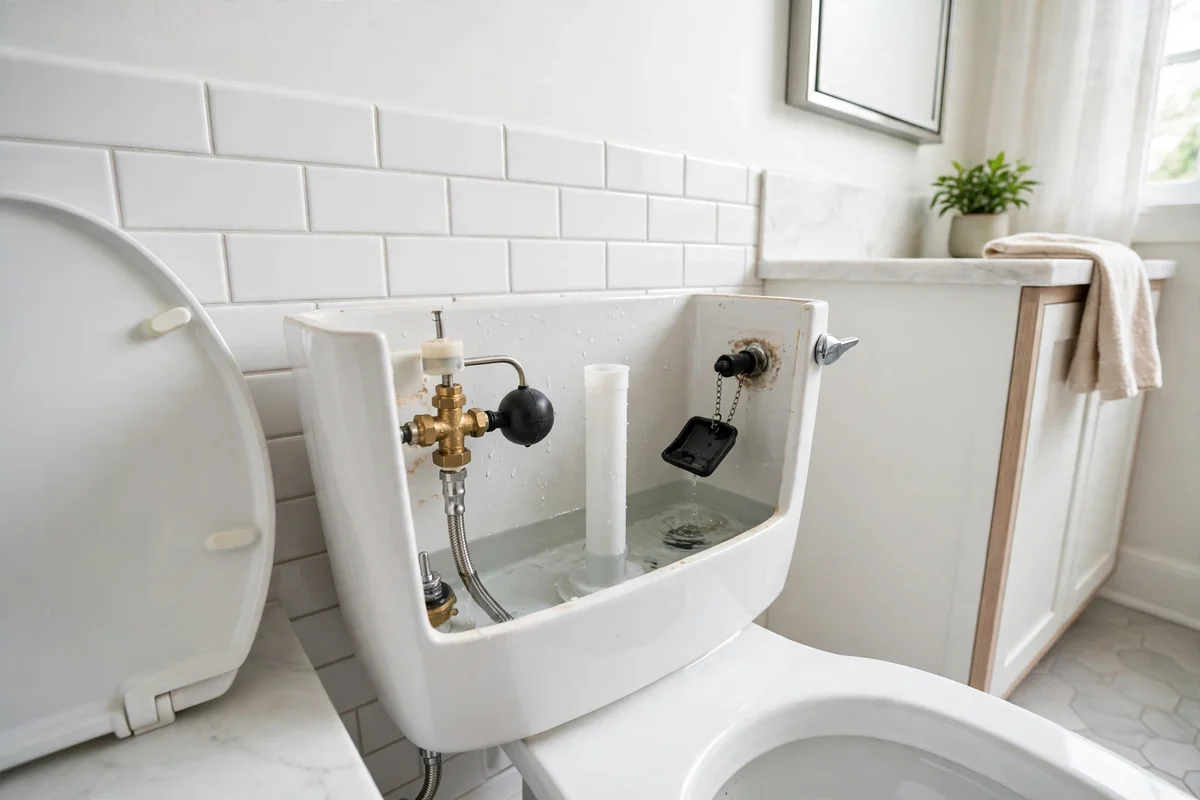
Inside a running toilet tank, showing the fill valve and flapper.
Why a Toilet Keeps Running
The tank of a toilet is a simple system with one job: hold water at a set level, release it quickly when you flush, then refill to the same level and stop. A running toilet is a tank that cannot complete that cycle. Water is either escaping from the tank into the bowl, so the fill valve keeps topping it up, or the fill valve itself will not shut off, so water keeps entering the tank and spilling into the overflow tube. Both faults produce the same sound, a hiss or trickle that never quite stops, and both waste water continuously until they are fixed.
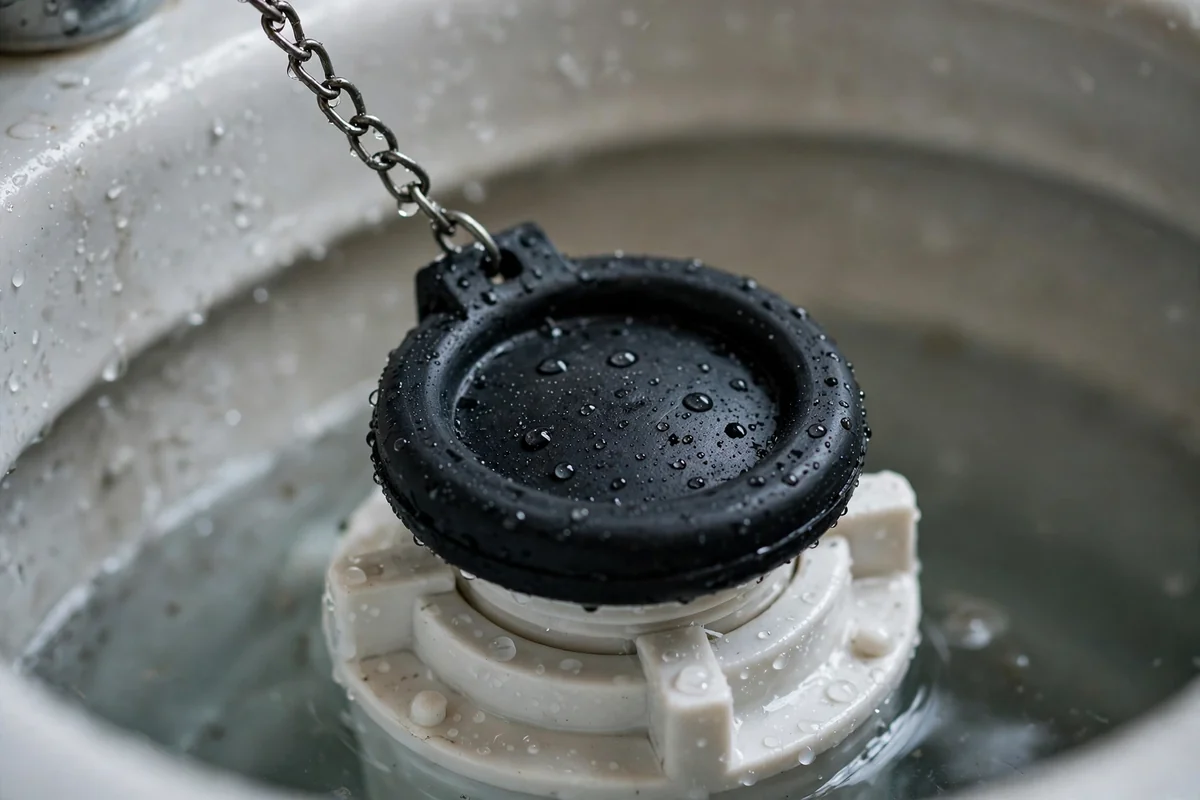
The flapper is the most common cause. It is a rubber seal at the bottom of the tank that lifts when you flush and drops back to hold water. Rubber sits in water all day, every day, and over years it hardens, warps and collects mineral deposits on the seat it rests on. Once it stops sealing cleanly, tank water seeps into the bowl in a slow, steady trickle. The tank level drops a little, the fill valve opens to top it up, and the cycle repeats. If the seep is slow, the toilet may only refill every few minutes, a pattern sometimes called a phantom flush, where the toilet sounds as if it has flushed by itself. If the seep is faster, the toilet runs without stopping at all.
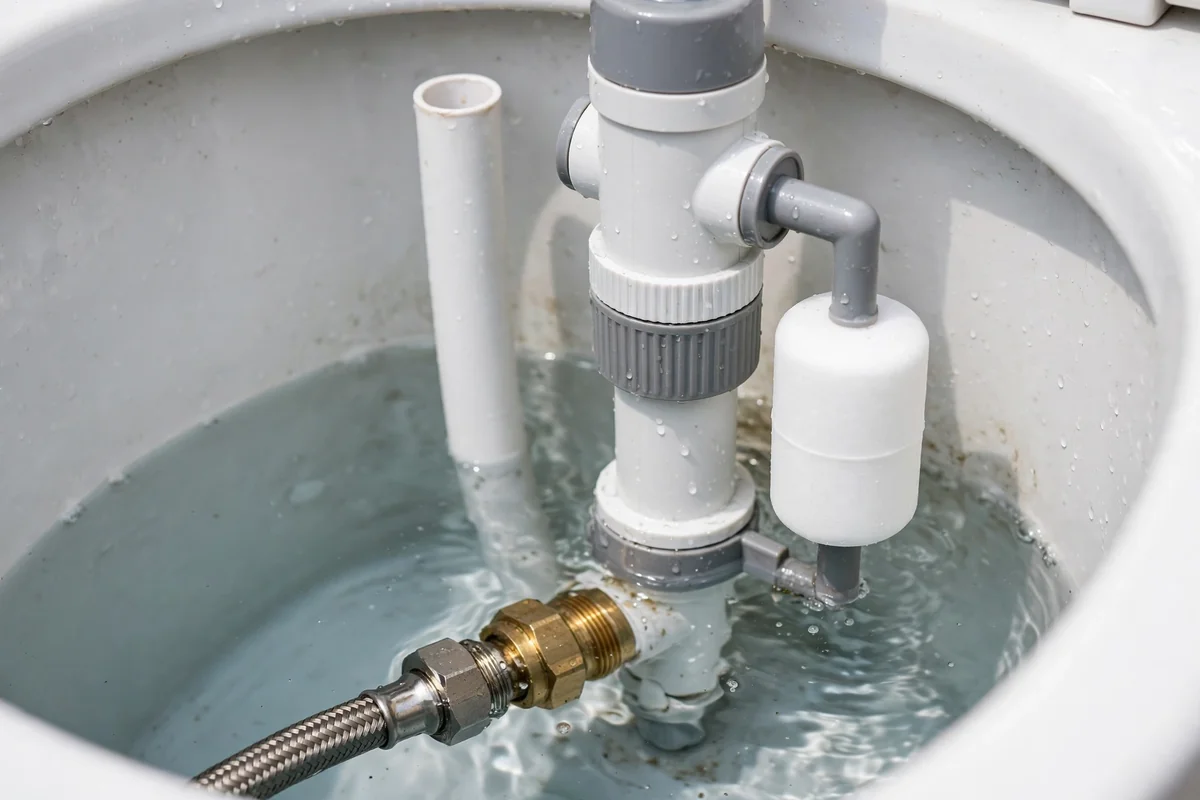
The fill valve is the second common cause. It is the tall valve on the side of the tank that refills the tank after a flush, controlled by a float that rises with the water level and shuts the valve off when the tank is full. If the float is set too high, water spills into the overflow tube before the valve shuts off, and the valve keeps running. If the valve itself is worn or clogged with debris, it may not shut off at all, or it may refill very slowly and hiss while it does so. A fill valve that is failing often shows up first as a toilet that takes a long time to refill, then as a toilet that never quite stops.
The chain and the overflow tube complete the picture. The chain connects the handle to the flapper, and it needs a small amount of slack, about half an inch. Too much slack and the flapper does not lift far enough, which weakens the flush. Too little slack, or a chain that has caught under the flapper, holds the flapper slightly open and the toilet runs. The overflow tube is a safety feature: it prevents the tank overflowing by directing excess water into the bowl. If it is cracked, or if the refill tube is pushing water directly into it at too high a rate, it can contribute to a running toilet as well. A local professional checks these parts in order, because the symptom alone does not say which one has failed.
The Dye Test: How to Tell Whether the Flapper Is Leaking
Add colour to the tank
Lift the tank lid carefully and set it aside on a towel. Add a few drops of food colouring to the tank water. Do not flush.
Wait fifteen minutes
Leave the toilet alone for about fifteen minutes. Do not flush, and do not use the toilet during the test.
Check the bowl
Look at the bowl water. If colour has appeared in the bowl without flushing, water is leaking past the flapper or the flush valve into the bowl.
Check the overflow tube
If the bowl is clear but the tank water level is at or above the top of the overflow tube, the fill valve is not shutting off at the right level.
Running Toilet Causes at a Glance
| Symptom | Most likely cause | What usually fixes it |
|---|---|---|
| Toilet runs without stopping | Flapper not sealing, or fill valve not shutting off. | Replace the flapper or the fill valve, and check the chain. |
| Toilet refills every few minutes | Slow flapper seep, the early stage of the same fault. | Replace the flapper and clean the flapper seat. |
| Toilet flushes by itself | Water seeping past the flapper, then the fill valve topping up. | Replace the flapper; the phantom flush stops when the seal holds. |
| Hissing from the tank | Fill valve letting water through, or water trickling into the overflow tube. | Adjust or replace the fill valve, and set the tank level correctly. |
| Tank takes a long time to refill | Fill valve worn or partly blocked, or supply valve not fully open. | Clean or replace the fill valve, and check the shutoff valve. |
| Water spilling into the overflow tube | Tank level set too high, or float not shutting the valve off. | Lower the float so the water sits below the top of the overflow tube. |
| Running started after a repair | Chain too tight, wrong flapper size, or refill tube misplaced. | Adjust the chain slack and check the parts match the toilet model. |
What a Running Toilet Costs in Water
A running toilet wastes water in a way that is easy to ignore, because there is no puddle and no visible leak. The water moves from the tank into the bowl and down the drain, silently, day and night. A toilet that refills every few minutes is moving water in small bursts all day. A toilet that runs without stopping is moving water continuously. The United States Environmental Protection Agency notes that household leaks can waste 180 gallons of water per week, and toilets are often the source. That figure covers household leaks in general, not a single toilet, but it gives a sense of scale: a leak that is invisible can still be substantial.
The water waste is not the only cost. A fill valve that cycles on and off every few minutes wears out faster than one that runs only after a flush. A flapper that seeps keeps the tank level dropping and rising, which stresses the fill valve and can make the toilet noisier over time. And a running toilet masks other problems: if the toilet is always making noise, a new sound, a gurgle from the drain or a hiss from the supply line, is easy to miss. Fixing the running toilet restores the quiet baseline that makes other problems noticeable.
There is also a practical point about Fountain Valley water. California limits new toilets to 1.28 gallons per flush, and WaterSense models are designed to use no more than that while flushing effectively. A running toilet undermines that efficiency entirely, because it uses water between flushes rather than during them. Replacing a worn flapper or fill valve is one of the simplest ways to bring a toilet back to the efficiency it was designed for, and it is a far smaller job than replacing the toilet itself. If the toilet is a pre-1994 model using 3.5 gallons or more per flush, the running problem and the efficiency question arrive together, and the toilet replacement page covers that decision.
What You Can Check Safely in the Tank
- Lift the tank lid carefully with both hands and set it on a folded towel on the floor, never balanced on the rim, because a porcelain lid can crack if it slips.
- Look at the water level. It should sit about half an inch to three quarters of an inch below the top of the overflow tube, and near the fill line marked inside the tank.
- Check the chain. It should have a small amount of slack, about half an inch, and should not be caught under the flapper or tangled around the flush valve.
- Look at the flapper. If it is warped, blistered, or leaves a dark mark on your fingers when you touch it, the rubber has hardened and is no longer sealing well.
- Listen for where the sound comes from. A trickle into the bowl points to the flapper. A hiss from the side of the tank points to the fill valve.
- Do the dye test described above before replacing any part, so you know whether the leak is past the flapper or through the overflow tube.
- Do not force the shutoff valve behind the toilet if it is stiff or corroded. A valve that snaps can leak, and that turns a running toilet into a supply leak.
Running Toilets in Fountain Valley Homes
Running toilets are common in Fountain Valley for a straightforward reason: the city housing stock is old enough that many toilets have had their rubber parts replaced at least once, and old enough that some have not. A flapper lasts several years in normal use, not decades, and a home built in the 1960s or 1970s that still has a toilet from an earlier replacement will have a flapper that has been in service far longer than it was designed for. The hard water across Orange County shortens that life further, because mineral deposits build up on the flapper seat and prevent a clean seal even when the flapper itself looks intact.
Rental properties show the same pattern in a different way. A running toilet in a rental may go unreported for months, because the tenant hears it as background noise and the owner does not see the water use until the bill arrives. Property managers who check units between tenancies often find a toilet that has been running for a long time, with a fill valve that has worn out from cycling and a flapper that has hardened. A quick check during a change of tenancy, listening for a hiss or a refill cycle, catches the problem before it becomes a larger repair.
The age mix of Fountain Valley toilets also means the parts are not always interchangeable. A flapper that fits one model may not seal on another, and a fill valve designed for a modern toilet may not fit an older tank correctly. That is why the make and model, usually marked inside the tank or on the lid, are worth noting before any part is bought. A local professional who sees the mix of toilets across Fountain Valley regularly can usually identify the right parts from the symptom and the model, and can explain when a tank part replacement is enough and when the toilet itself is the problem.
When a Running Toilet Needs Prompt Help
- The toilet runs without stopping and the tank never reaches a quiet, full level.
- Water is spilling into the overflow tube or the tank is overfilling.
- The toilet refills every few minutes, day and night, and the sound is getting worse.
- The shutoff valve behind the toilet is stiff, corroded or leaking when you try to turn it.
- The flapper or fill valve has been replaced and the toilet still runs.
- Water is appearing on the floor around the toilet as well as in the tank.
Fill Valve Types and Tank Water Levels
The fill valve is the tall valve on the side of the tank that refills the tank after a flush, and it comes in two main types that Fountain Valley homeowners are likely to meet. The older type uses a ball float on an arm: as the tank fills, the ball rises, the arm lifts, and the valve shuts off when the water reaches the set level. The newer type uses a cylindrical float that slides up and down the valve body itself, and it is adjusted with a clip or a screw rather than by bending an arm. Both types do the same job, and both can fail in the same ways, but they are adjusted differently, which is why knowing which type is in the tank matters before anyone tries to adjust it.
The tank water level is the setting that matters most, and it is also the one most often set wrong. The water should sit about half an inch to three quarters of an inch below the top of the overflow tube, and near the fill line marked on the inside of the tank. If the level is too high, water spills into the overflow tube continuously and the toilet runs. If the level is too low, the tank holds too little water to generate a strong flush, and the toilet flushes weakly. The level is set by adjusting the float: on a ball float valve, by bending the arm gently or turning the adjustment screw; on a cylinder float valve, by moving the clip or turning the screw on the float. A small adjustment, a quarter of an inch at a time, followed by a flush and a check of where the water stops, is the right approach. A large adjustment in one go usually overshoots the level in the other direction.
The refill tube is a small part that causes a surprising number of running toilets. It is the thin tube that runs from the fill valve to the overflow tube, and its job is to direct a small amount of water into the bowl after a flush, so the bowl refills to its normal level. If the refill tube is pushed too far down into the overflow tube, it can siphon water out of the tank and into the bowl, and the toilet will run. If the refill tube has come off the fill valve entirely, the bowl may not refill properly after a flush, and the water level in the bowl will sit low. The tube should sit just above the top of the overflow tube, clipped in place, not pushed down inside it. That is a thirty-second check that solves a running toilet more often than most people expect.
Debris in the water supply is another cause of fill valve trouble, and it is more common after water supply work in the street or in the home. A small particle can lodge in the fill valve and prevent it shutting off cleanly, so the toilet hisses or runs. The valve can often be cleaned by turning off the water, removing the cap on top of the fill valve, and flushing out the debris, though the exact steps depend on the valve model and the manufacturer instructions. If the valve is old and the seal inside it has hardened, cleaning will not help and the valve needs to be replaced. A fill valve that has been cycling on and off every few minutes because of a leaking flapper wears out faster than one that runs only after a flush, which is why a running toilet should be fixed promptly rather than left for months.
There is one more fill valve symptom worth knowing about, because it is easy to misread: a toilet that takes a long time to refill after a flush. That usually means the fill valve is worn or partly blocked, or the shutoff valve behind the toilet is not fully open. It can also mean the supply line is restricted, though that is less common. A slow refill is not urgent in the way an overflow is, but it is a sign that the valve is failing, and it will usually get worse rather than better. If the toilet also runs or hisses, the fill valve is the likely cause and replacement is the usual answer. A local professional can check the fill valve, the float setting and the refill tube in a single visit, and can tell you whether an adjustment is enough or whether the valve needs to be replaced.
Call for Running Toilet Repair in Fountain Valley
A toilet that runs all day is wasting water with every hour that passes. Call now to describe what the tank is doing and connect with a local toilet repair professional who can discuss the help available.
Fountain Valley Toilet Repair Pros is a referral service connecting customers with local toilet repair professionals; it is not itself the service company.
Frequently Asked Questions
What makes a toilet run all the time?
The most common cause is a flapper that no longer seals, so water seeps from the tank into the bowl and the fill valve keeps topping the tank up. A fill valve that will not shut off, a chain that is too tight, or a tank level set too high can cause the same symptom. The dye test shows whether the leak is past the flapper.
What is a phantom flush?
A phantom flush is when a toilet sounds as if it has flushed by itself, usually at night. It happens when a worn flapper lets tank water seep slowly into the bowl, the tank level drops, and the fill valve opens to top it up. The refill sounds like a flush. Replacing the flapper stops the cycle.
How do I know if the flapper or the fill valve is the problem?
Do the dye test: add food colouring to the tank, wait fifteen minutes without flushing, and check the bowl. Colour in the bowl means water is leaking past the flapper. If the bowl is clear but water is spilling into the overflow tube, the fill valve is not shutting off at the right level.
Can I fix a running toilet by adjusting the chain?
Sometimes. The chain needs a small amount of slack, about half an inch. If it is too tight, it holds the flapper slightly open and the toilet runs. If it is too loose, the flapper does not lift far enough and the flush is weak. If adjusting the chain does not stop the running, the flapper or fill valve is the likely cause.
Why does my toilet hiss?
A hiss from the tank usually means the fill valve is letting water through when it should be shut, or water is trickling into the overflow tube because the tank level is set too high. A worn flapper that lets water seep into the bowl can also make the fill valve cycle on and off, which produces a similar sound.
How much water can a running toilet waste?
A toilet that runs without stopping wastes water continuously, and one that refills every few minutes wastes water in small bursts all day. The United States Environmental Protection Agency notes that household leaks can waste 180 gallons of water per week, and toilets are often the source. Fixing the flapper or fill valve stops the waste at its source.
Should I replace the flapper or the whole flush valve?
Start with the flapper, because it is the part that seals the tank and the most common cause of a running toilet. If a new flapper of the correct size still does not seal, the flush valve seat may be damaged or coated with mineral deposits, and the flush valve itself may need attention. A local professional can check the seat before deciding.
Why does my toilet take so long to refill?
A slow refill usually means the fill valve is worn or partly blocked with debris, or the shutoff valve behind the toilet is not fully open. It can also mean the supply line is restricted. If the toilet also runs or hisses, the fill valve is the likely cause and replacement is the usual answer.
Can hard water cause a toilet to run?
Yes. Mineral deposits from hard water build up on the flapper seat and inside the fill valve, preventing the flapper sealing cleanly and the valve shutting off properly. Cleaning the deposits helps, but a flapper that has hardened with age and scale usually needs to be replaced rather than cleaned.
What if my toilet still runs after I replace the flapper?
Check that the replacement flapper is the correct size and type for the toilet model, that the chain has the right amount of slack, and that the refill tube is not pushing water directly into the overflow tube. If those are correct and the toilet still runs, the fill valve or the flush valve seat may be the cause.
Need Toilet Repair? Call Now
Describe the toilet problem and discuss the help available for your specific situation.