Toilet Replacement in Fountain Valley, CA
Toilet replacement means removing an existing toilet and installing a new one in its place. Most toilet problems are repairs, not replacements, and a toilet with sound porcelain and a single worn part should usually be repaired. Replacement is the sensible answer when the bowl or tank is cracked, the toilet keeps failing after repairs, the base leaks after a new seal, or the toilet is an old high-flow model that uses far more water per flush than a modern one.
Toilet repair assistance for homes, rentals, and local properties.
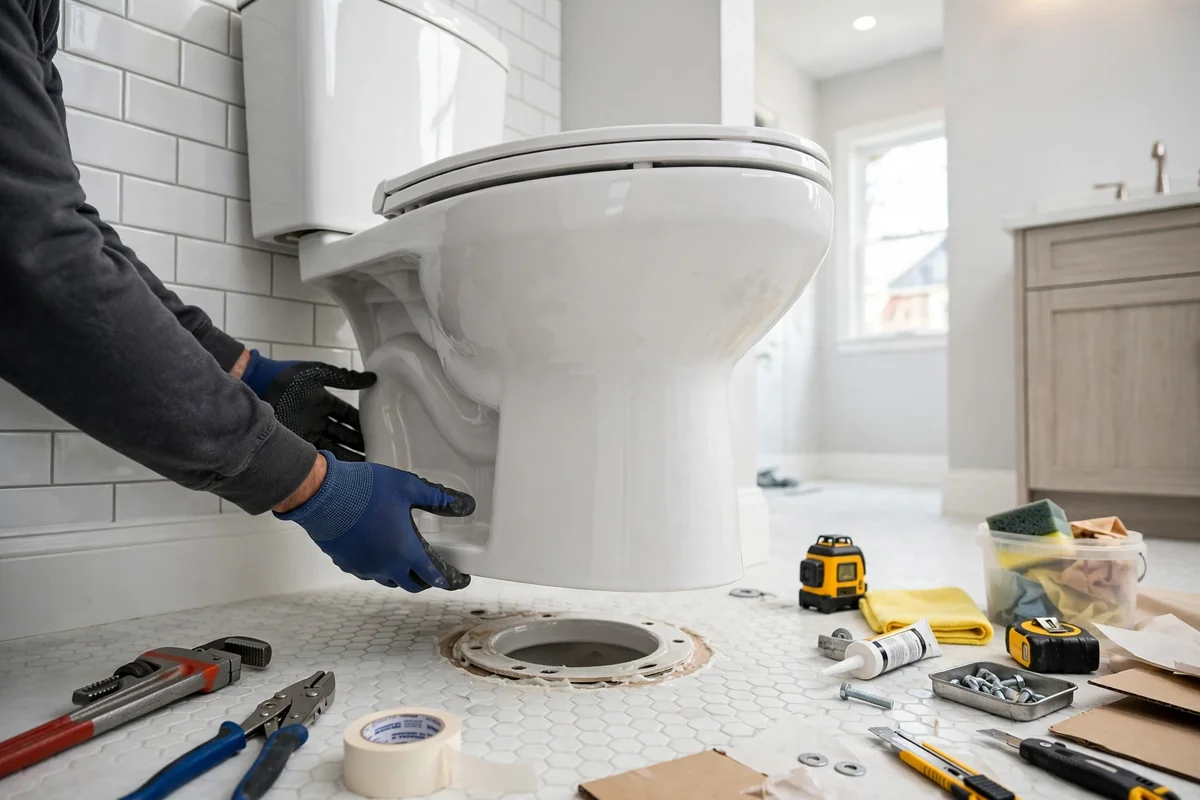
A new toilet being installed in a renovated bathroom.
Repair or Replace: The Decision in Plain Terms
The decision between repairing and replacing a toilet comes down to three questions: is the porcelain sound, is the problem a single part or a pattern of failures, and how much water does the toilet use. If the porcelain is sound and the problem is one worn part, a flapper, a fill valve, a handle or a wax ring, repair is almost always the answer. Those parts are inexpensive, the work is straightforward, and the toilet will work as well as it did before. If the problem is a crack in the bowl or tank, repair is not a real option, because porcelain under constant water pressure does not hold a patch reliably, and a crack below the waterline will leak.
The second question is about pattern. A toilet that needs a new part every few months is describing a fixture at the end of its serviceable life, even if each individual repair is possible. The parts are wearing out together because they are all the same age, and fixing one reveals the next weakness. A toilet that clogs with normal use, even when the drain is clear and the rim jets are clean, is also describing a bowl that no longer flushes with enough force. Early low-flow toilets from the mid-1990s are the classic example: they were the first generation built to the 1.6-gallon federal standard, and many of them flush weakly by modern standards. Replacing that toilet solves the clogging in a way that no part replacement can.
The third question is about water. Toilets built before 1994, when federal law capped new toilets at 1.6 gallons per flush, typically use 3.5 gallons or more every time they flush. Modern WaterSense models use 1.28 gallons per flush or less, and they are independently tested for both performance and efficiency, so they flush better than the early low-flow models while using less water. The United States Environmental Protection Agency notes that replacing old, inefficient toilets with WaterSense models can reduce water used for toilets by 20 to 60 percent for the average family. If a pre-1994 toilet needs to be lifted anyway, because the wax ring has failed or the flange needs work, that is a sensible moment to replace it rather than resetting a toilet that will keep using far more water than a modern one.
Age alone is not a reason to replace a toilet. A toilet that is twenty years old, flushes well, does not leak and has had its tank parts replaced when they wore out is a sound toilet. A toilet that is ten years old, cracked, rocking and clogging is not. The age matters only in combination with the symptoms: how often it fails, how it flushes, and how much water it uses. A local professional can look at the toilet, the symptoms and the age together and explain which side of the line a particular toilet falls on, rather than applying a rule based on age alone.
Signs It Is Time to Replace a Toilet
- A crack in the bowl or tank, especially a crack below the waterline, which will leak and cannot be reliably sealed.
- The base keeps leaking after a new wax ring and a flange check, which points to damage in the toilet itself or the floor beneath it.
- The toilet needs a new part every few months, and the failures keep coming in different parts of the fixture.
- The toilet clogs with normal use even when the drain is clear, the rim jets are clean and the tank level is correct.
- The toilet is a pre-1994 model using 3.5 gallons or more per flush, and it needs work that requires lifting it anyway.
- The porcelain is stained, the glaze is worn, or the bowl has surface damage that makes it hard to keep clean.
- You are remodelling the bathroom and the existing toilet does not match the new layout, height or style you need.
- The floor around the toilet is soft or damaged, and the toilet has to come up for floor work in any case.
Choosing a New Toilet: What Actually Matters
| Feature | What to look for | Why it matters |
|---|---|---|
| Flush volume | WaterSense label, 1.28 gallons per flush or less. | Uses less water per flush than the 1.6-gallon federal standard, with independently tested flushing performance. |
| Rough-in distance | Measure from the wall to the centre of the floor bolts: usually 10, 12 or 14 inches. | The new toilet must match the existing drain position, or the drain has to move. |
| Bowl shape | Round or elongated bowl, matched to the space in front of the toilet. | Elongated bowls are more comfortable but need more room; round bowls suit smaller bathrooms. |
| Bowl height | Standard height or comfort height, matched to who uses the bathroom. | Comfort height suits taller users and people with limited mobility; standard height suits children better. |
| Flushing system | Gravity flush for most homes; pressure-assisted for stronger flushing where needed. | Gravity models are quieter and simpler; pressure-assisted models flush harder but are louder. |
| Trapway size | A larger, fully glazed trapway where the model offers it. | A wider, smoother trapway clogs less easily and clears the bowl more reliably. |
| One-piece or two-piece | One-piece is easier to clean; two-piece is lighter and easier to carry upstairs. | One-piece toilets have no tank-to-bowl joint to leak; two-piece toilets are easier to handle during installation. |
What a Toilet Replacement Involves
Measure and choose
The rough-in distance is measured from the wall to the centre of the floor bolts, the height of the flange is checked, and the floor condition is noted. The new toilet is chosen to match those measurements.
Remove the old toilet
The water is turned off, the tank and bowl are drained, the supply line is disconnected, and the old toilet is lifted and removed. The flange and the floor underneath are inspected.
Prepare the flange and floor
A cracked or corroded flange is repaired or replaced before anything else goes on it, because a new toilet on a bad flange will rock and leak just like the old one.
Set the new toilet
A new wax ring or non-wax seal is fitted, the toilet is set level and bolted down, and a new supply line is connected. The toilet is flushed several times and the base, tank bolts and supply connection are checked for leaks.
Rough-In, Flange and Floor: The Measurements That Decide the Fit
The rough-in is the distance from the finished wall behind the toilet to the centre of the floor bolts that hold the toilet down, and it is the measurement that decides whether a new toilet will fit the existing drain. Most homes have a 12-inch rough-in, but 10-inch and 14-inch rough-ins are common in older homes and in bathrooms where the layout is unusual. A toilet built for a 12-inch rough-in will not fit a 10-inch drain position, and a toilet built for a 10-inch rough-in will sit too far from the wall on a 12-inch drain. Measuring before buying is the step that prevents the most common replacement mistake, and it takes less than a minute with a tape measure.
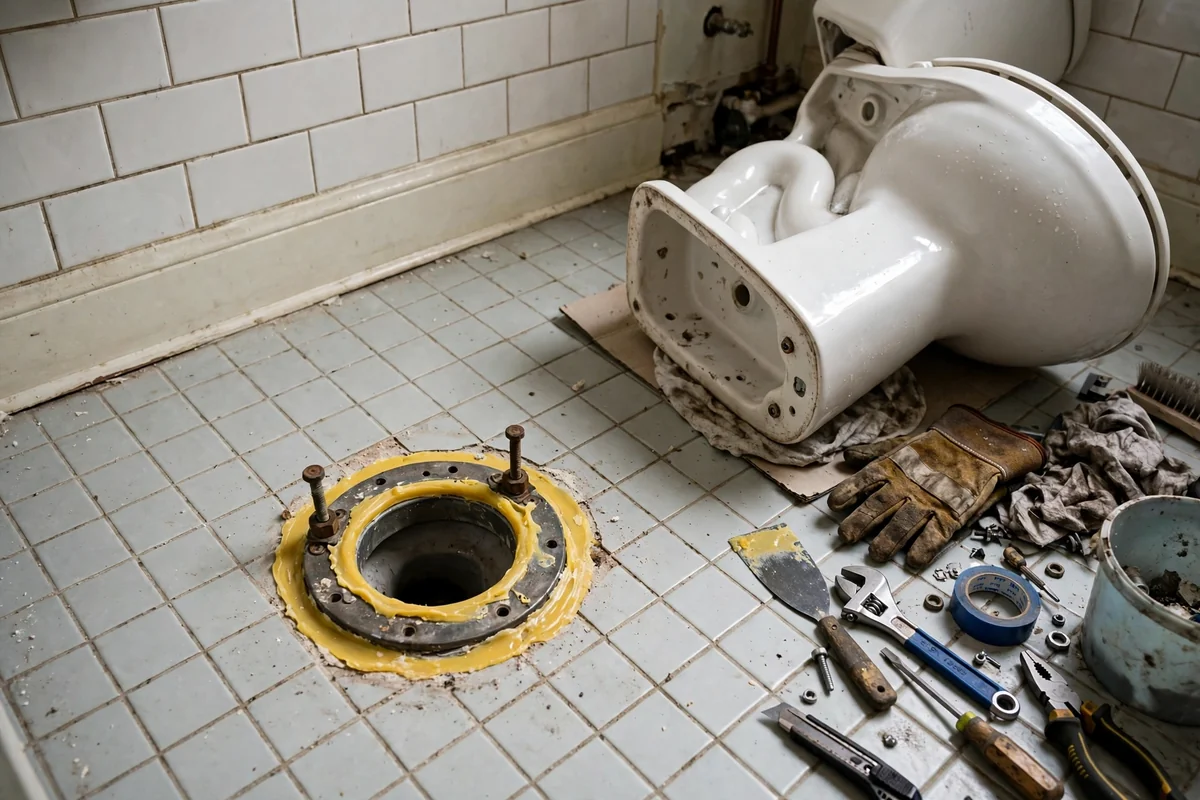
The flange is the second measurement that matters. It should sit level with the finished floor, or slightly above it, and it should be firmly fixed to the subfloor. If the flange sits too low, because a new floor was laid over the old one, the wax seal will be thin and the toilet may rock. If the flange is cracked or corroded, the toilet will not hold a seal at all. A replacement visit is the right time to fix the flange, because the toilet is already off the floor and the fitting is fully accessible. A new toilet set on a repaired flange will hold its seal for years. A new toilet set on a damaged flange will leak like the old one, and the replacement will have solved nothing.
The floor underneath is the third check, and it is the one that can change the scope of the job. When the old toilet is lifted, the subfloor is visible for the first time in years, and it can reveal soft or rotted wood from a slow base leak, a stain on the ceiling below, or damage that was hidden under the toilet. If the floor is sound, the replacement proceeds. If the floor is damaged, the toilet stays off until the floor is repaired, because setting a new toilet on a rotted subfloor guarantees the seal will fail again. That inspection is one of the real benefits of a replacement visit: it is the only time the floor under the toilet can be seen and checked properly.
There is also a practical point about carrying a toilet. A two-piece toilet separates into tank and bowl, and each piece is light enough to carry upstairs or through a narrow bathroom door. A one-piece toilet is heavier and harder to handle, though it is easier to clean once installed because it has no joint between tank and bowl. Which one suits a particular bathroom depends on the access to the room, the people who will use it, and how the toilet will be carried in. Those are details worth discussing before the toilet is bought, rather than discovering them on the day of the installation.
WaterSense and California Efficiency
California limits new toilets to 1.28 gallons per flush, which is 20 percent less than the federal standard of 1.6 gallons per flush. WaterSense is the United States Environmental Protection Agency program that certifies toilets meeting that efficiency level while also passing independent performance testing, so a WaterSense toilet is not just using less water, it has been tested to flush effectively at that volume. That matters because the early low-flow toilets of the 1990s earned a reputation for weak flushing, and many Fountain Valley homeowners still associate low water use with poor performance. Modern WaterSense models are designed to avoid that trade-off, with larger trapways, glazed passages and bowl designs that clear waste reliably at 1.28 gallons per flush.
The water saving from a replacement is real but it depends on what is being replaced. Replacing a pre-1994 toilet that uses 3.5 gallons or more per flush with a 1.28-gallon WaterSense model cuts the water per flush by more than half, on every flush, for as long as the toilet is in service. Replacing a 1.6-gallon toilet with a 1.28-gallon model saves less per flush, and the case for replacement then rests on the condition of the old toilet rather than on water saving alone. The Environmental Protection Agency notes that the average family can reduce water used for toilets by 20 to 60 percent by replacing old, inefficient toilets with WaterSense models, a range that reflects how much water the old toilets were using.
Dual-flush toilets offer a further option. They provide a full flush for solids and a reduced flush for liquids, using less water on the lighter flush. They suit households that want to save water without changing how they use the toilet, though they have more parts inside the tank than a single-flush model, and those parts need to be the right ones for the model. Whether a dual-flush or a single-flush model is the sensible choice depends on the household, the bathroom, and the toilet that is being replaced, and it is a question worth discussing with the local professional rather than deciding from a label alone.
One practical point about choosing a replacement deserves emphasis: the toilet that looks right in a showroom may not be the toilet that fits the bathroom at home. The rough-in measurement, the space in front of the bowl, the height of the seat, and the position of the supply valve all decide the fit, and none of them can be judged from a photograph. Measuring the rough-in, the distance from the wall to the centre of the floor bolts, and the clear space in front of the toilet before buying prevents the most common replacement mistake, which is a toilet that sits too far from the wall or too close to the door. A local professional can take those measurements during a visit and explain which models will fit, so the choice is made with the bathroom in mind rather than in isolation.
Toilet Replacement in Fountain Valley Homes
Fountain Valley is a city where toilet replacement is a common job, because the housing stock is old enough that many toilets are on their second or third fixture. Homes built in the 1960s and 1970s in Green Valley, Westmont, Los Caballeros and around Mile Square Regional Park have had their bathrooms updated at different times, and a house can contain toilets from three different eras. When one of those toilets reaches the point where repair no longer makes sense, replacement is usually straightforward, because the drain position, the water supply and the bathroom layout are already in place. The work is a fixture replacement, not a remodelling job.
Bathroom remodelling is the other common trigger for replacement in Fountain Valley. When a bathroom is retiled or refitted, the toilet usually comes out in any case, and that is the sensible moment to replace a toilet that was already showing its age, rather than resetting an old fixture onto a new floor. The flange height should be checked whenever the floor level changes, because a new floor laid over the old one can leave the flange too low for a proper seal. A replacement planned alongside a flooring change avoids that problem entirely, because the flange can be raised to match the new floor before the new toilet is set.
Rental properties and multi-unit buildings have their own replacement pattern. A toilet in a rental that clogs repeatedly, runs, or needs a new part every few months creates repeated callouts and tenant inconvenience, and replacing it once is often simpler than repairing it several times. A property manager replacing toilets across several units should note the rough-in measurements for each bathroom, because they are not always the same across a building, and a toilet bought for one unit may not fit another. The toilet repair hub page covers the general repair process, and the toilet problems page explains the symptoms that lead to a replacement decision.
Call for Toilet Replacement in Fountain Valley
If your toilet is cracked, keeps failing, or uses far more water than a modern model, call now to discuss whether replacement is the sensible answer and connect with a local toilet repair professional.
Fountain Valley Toilet Repair Pros is a referral service connecting customers with local toilet repair professionals; it is not itself the service company.
Frequently Asked Questions
When is it better to replace a toilet than repair it?
Replacement is usually better when the bowl or tank is cracked, the base keeps leaking after a new seal, the toilet needs a new part every few months, it clogs with normal use even when the drain is clear, or it is a pre-1994 model using far more water per flush than a modern WaterSense model. Repair is usually better when the porcelain is sound and the problem is a single worn part.
How do I measure the rough-in for a new toilet?
Measure from the finished wall behind the toilet to the centre of the floor bolts that hold the toilet down. Most homes measure 12 inches, but 10-inch and 14-inch rough-ins are common in older homes. The new toilet must match that measurement, or the drain position has to move.
What is a WaterSense toilet?
A WaterSense toilet carries the United States Environmental Protection Agency's WaterSense label, which requires no more than 1.28 gallons per flush while passing independent performance testing. That is 20 percent less than the federal standard of 1.6 gallons per flush. The label means the toilet has been tested to flush effectively at that volume.
How long does a toilet replacement take?
A standard replacement, where the flange and floor are sound, is usually completed in a single visit, and the toilet is flushed several times and checked for leaks before the visit ends. If the flange is damaged or the floor underneath needs repair, the work takes longer because the toilet stays off until the floor is sound.
Can a new toilet be installed on the old wax ring?
No. A wax ring is compressed when the toilet is set down, and it cannot be reused once the toilet has been lifted. Every toilet that is removed, whether it is being reset or replaced, needs a new wax ring or non-wax seal, and the flange should be inspected at the same time.
What should I do with my old toilet after replacement?
Ask the local professional what happens to the old toilet when you call. Old toilets are heavy porcelain fixtures, and they need to be handled and disposed of properly rather than left at the kerb without checking local collection rules. The replacement visit usually includes removing the old unit from the bathroom.
Is a one-piece or two-piece toilet better?
A one-piece toilet is easier to clean because it has no joint between tank and bowl, but it is heavier and harder to carry upstairs. A two-piece toilet separates into tank and bowl, so each piece is lighter to handle, but it has a tank-to-bowl joint that can leak over time. Which suits a bathroom depends on access, who uses it, and how it will be carried in.
Will a new toilet fix my clogging problem?
It will if the clogging is caused by the toilet itself, for example an early low-flow bowl that flushes too weakly or a trapway that is damaged. It will not help if the clogging is caused by a partial blockage in the drain line or a blocked vent, because those problems are beyond the toilet. The cause should be diagnosed before a replacement is chosen.
Do I need a different toilet for a small bathroom?
A small bathroom usually suits a round-bowl toilet, which needs less room in front of it than an elongated bowl, and a 10-inch rough-in model if the drain position requires it. Measure the space in front of the toilet and the rough-in distance before choosing, so the new toilet fits the room as well as the drain.
What is comfort height for a toilet?
Comfort height, also called chair height, is a taller toilet seat height that suits taller users and people who find it hard to sit down low or stand up from a standard-height toilet. Standard height suits children better. The choice depends on who uses the bathroom most often.
Need Toilet Repair? Call Now
Describe the toilet problem and discuss the help available for your specific situation.